• Home
  • About
  • Services
  • Education
  • Behavior
  • Resources
  • Shopping
  • Contact
  • Calendar
  • Policies

Paws Whiskers & Claws, The Feline Hospital

Georgia's premier cat hospital - servicing Marietta, Roswell, Sandy Springs, Atlanta, Vinings, Cumming, Alpharetta, Morningside, Smyrna

(770) 579-6001

4719 Lower Roswell Road, Suite 220
Marietta, Georgia, 30068
  • Home
  • About
  • Services
  • Education
  • Behavior
  • Resources
  • Shopping
  • Contact
  • Calendar
  • Policies

The Nina Ottosson Dog Treat Maze

This is a very complicated food puzzle. It is two sided, features a maze within the toy on both sides and requires the cats to wobble or flip the toy entirely to dispense food. As this video demonstrates, not all hunting expeditions are successful. She walks away without success but that is ok, intermittent reinforcement keeps the animal doing the behavior! Practice makes perfect. Remember that novel food is helpful to stimulate interest and drive motivation. If your goal is weight loss or busting boredom the toys should be challenging and make them work hard!

This post and all of its content is written by and property of Ingrid Johnson, CCBC Certified Cat Behavior Consultant of Fundamentally Feline, LLC.
Filed Under: Food Puzzles Tagged With: Food puzzles for cats, Foraging toys for cats, rolling puzzles

Flower Tower by Trixie Pet

This is an intricate, brains over brawn, food puzzle originally designed for dogs, but that won't stop us! This puzzle features four swiveling layers but access is only granted once the large base cones are removed. That is the challenge, the cat must do one section of the puzzle in efforts for the next to be revealed. All levels can be rearranged for constant variety! This is definitely a toy for the experienced forager.

This post and all of its content is written by and property of Ingrid Johnson, CCBC Certified Cat Behavior Consultant of Fundamentally Feline, LLC.
Filed Under: Food Puzzles Tagged With: dog activity, environmental enrichment, environmental necessities, feline games, food dispensing toys, Food puzzles for cats, stationary food puzzles, Stationary food puzzles for cats, Stationary foraging toys, Trixie Pet, wet food foraging

Catit Play Stationary Foraging Board

This stationary foraging board offers a myriad of different obstacles, can be used for wet or dry food and can be enjoyed by both novice and experienced foragers. Placing the food only in the center of the board increases the challenge and requires the cats to then extract food from a secondary puzzle at the perimeter. Not only is this toy stylish, it is well made, easy to clean and versatile.

This post and all of its content is written by and property of Ingrid Johnson, CCBC Certified Cat Behavior Consultant of Fundamentally Feline, LLC.
Filed Under: Food Puzzles Tagged With: Catit, foraging toys, Foraging toys for cats, Fundamentally Feline, Hagen, loose the bowl, Stationary food puzzles for cats

The Snoop

Yet another toy designed and marketed for dogs that is great for cats as well. This toy can work for dry or wet food and can be manipulated to achieve different challenge levels, though as a whole it is a beginner toy.

This post and all of its content is written by and property of Ingrid Johnson, CCBC Certified Cat Behavior Consultant of Fundamentally Feline, LLC.

Filed Under: Food Puzzles Tagged With: environmental enrichment, environmental necessities, Food puzzles for cats, Foraging toys for cats, Fundamentally Feline, Planet Dog, rolling puzzles, The Snoop, wet food puzzles

The Bob-A-Lot

This is a weighted and challenging food puzzle designed originally for small to medium sized dogs, but is no match for an experienced foraging cat! Featuring an adjustable opening and a difficult to grip exterior, this toy is sure to slow down a cat that eats too quickly.

This post and all of its content is written by and property of Ingrid Johnson, CCBC Certified Cat Behavior Consultant of Fundamentally Feline, LLC.

Filed Under: Food Puzzles Tagged With: Bob-A-Lot, difficult foraging toys, environmental enrichment, Food puzzles for cats, foraging toys, Foraging toys for cats, lose the bowl, Rolling food puzzles, Starmark

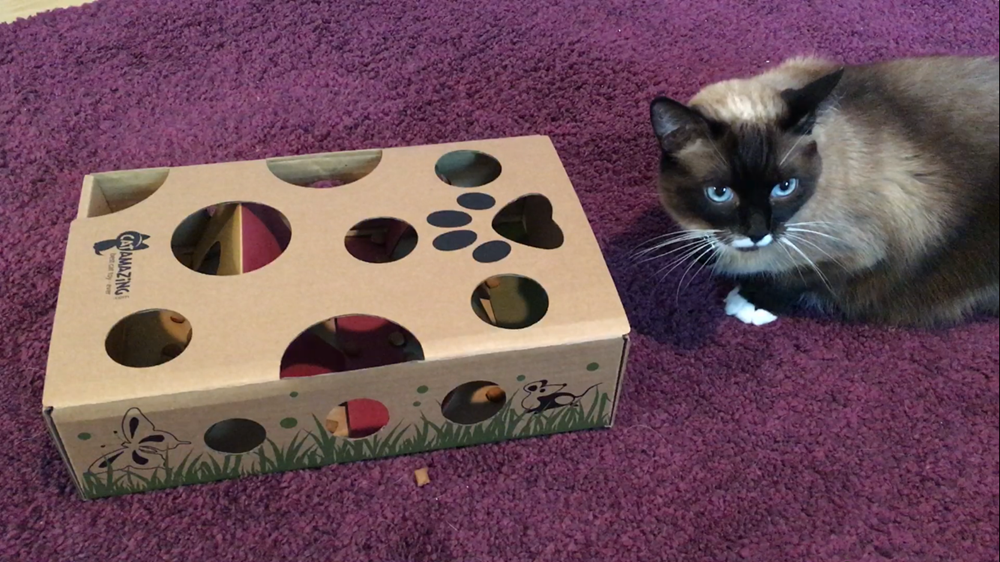
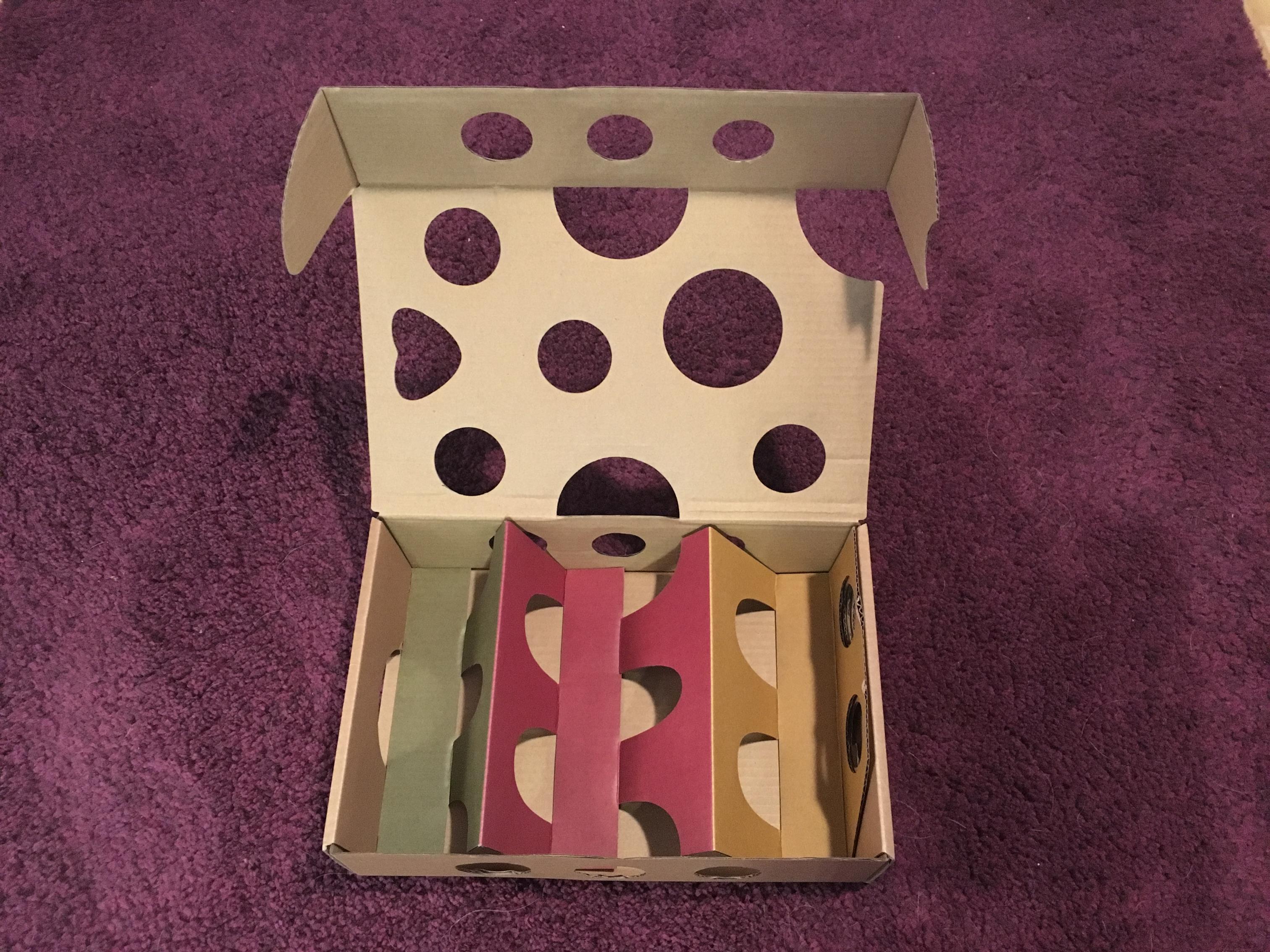
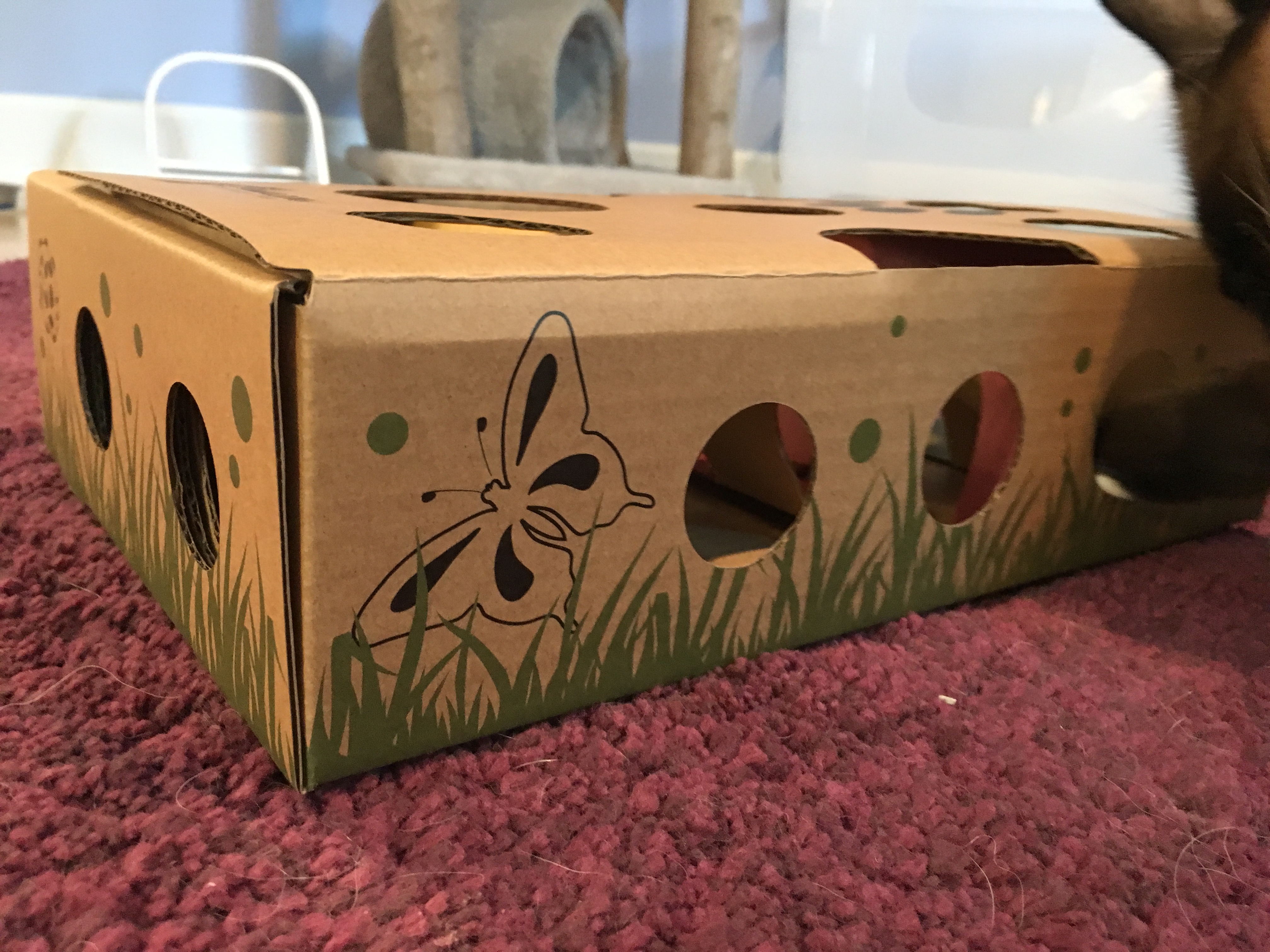
Cat Amazing

IMG_1882 (Copy)

This foraging box is complex and unique as it offers many different compartments for a unique foraging experience. For those looking for products not made of plastic this is a nice alternative. It is a more challenging stationary toy for the more experienced forager.

IMG_1878 (Copy)
IMG_1870 (Copy)
IMG_1877

This post and all of its content is written by and property of Ingrid Johnson, CCBC Certified Cat Behavior Consultant of Fundamentally Feline, LLC.

Filed Under: Food Puzzles Tagged With: cat amazing, environmental enrichment, food dispensing toys, Food puzzles, Food puzzles for cats, foraging, foraging toys, Foraging toys for cats, Fundamentally Feline

Food Rewards Suitable for Training and Medicating

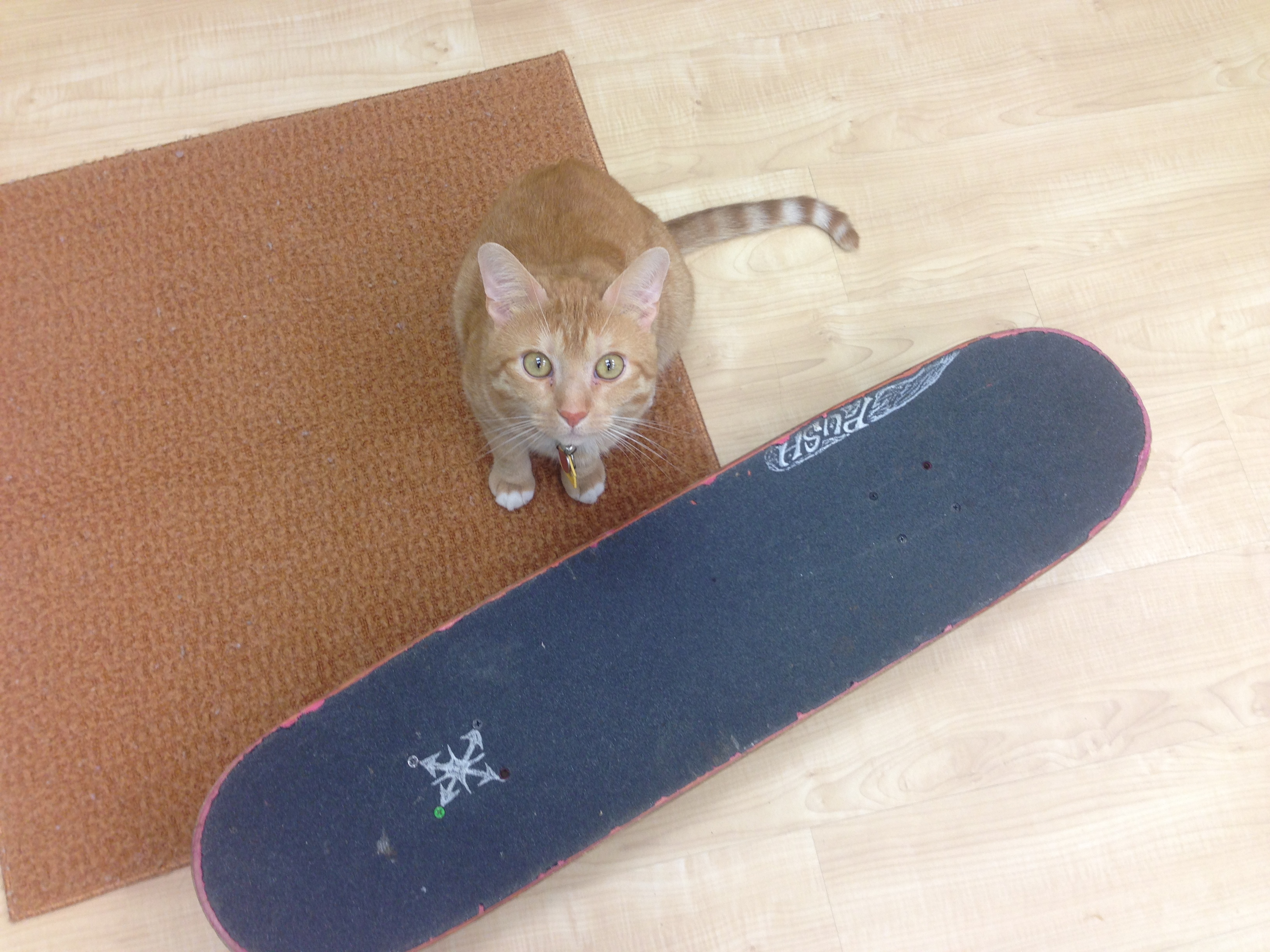
Cats are trainable and can be quite easy to medicate. It is all about finding something that motivates them to make it worth their while. The key to this being successful is keeping the reward novel; do not burn them out on it. Humans struggle with this part. Be stingy with your rewards and before you know it your cat will be doing all kinds of tricks like sit, hi-five, and even riding a skateboard! Not to mention eating their pills willingly! That's right, just take a look at the photos below to see how many cats can be trained to come to you at meds time.

Meats:

Canned cat food-generally something different than you offer each day

Hill’s a/d, Royal Canin Recovery, Purina CN (these Rx diets are ultra hi-calorie and should only be used for medicating & positive reinforcement)

Single ingredient, plain meat human baby food (ham, chicken, beef, turkey) NO onions!

Broths-chicken and beef broth (low/no sodium), tuna, oyster or clam juice

Deli meat, boiled chicken, sardines, salmon, SPAM! (yes, Spam)

Dairy: *most cats are lactose intolerant-use sparingly*

Milk, cream, heavy whipping cream, whipped cream cheese, yogurt, vanilla ice cream, cheese (any version), squeeze cheese, sour cream, and the like

Outside the box ideas:

Mini marshmallows (they make a great pill pocket)

Banana or Peanut Butter

Davis learned how to ride a skateboard being rewarded with delicious treats.
Did you ever think that your cats would be eager for their medications?
Cats of various ages on different meds but all enthusiastic for meds time!

Traditional cat treats:

Freeze dried meat treats (Purebites-chicken & turkey or Halo’s Liv-a-littles)

Greenie’s dental treats or Greenie’s Smartbites

Temptations, Pounce, Whisker Lickin’s, Party Mix (considered junk food and a last resort for sick old seniors that need medications).

Any dry food other than their regular dry food can also be a treat.

*always check with your veterinarian first

Need More Help?

Watch this video for more medicating tips!

Medicating Tips
Cats are VERY trainable, but ya gotta pay 'em!
Get them accustomed to the routine young, BEFORE they need daily meds.
Davis giving Ingrid a Hi- Five!

Written by Ingrid Johnson, CCBC Certified Cat Behavior Consultant of Fundamentally Feline  Photos property of Ingrid Johnson

Filed Under: General Tagged With: food rewards for cats, medicating tips for cats, positive reinforcement

Adoption Considerations

Download PDF Version

Thinking about adopting a cat? Ensure it’s a success with these tips!

In spite of their reputation for being solitary animals, cats are actually very social creatures who enjoy the company of other cats and sometimes even dogs. Many behavior problems exhibited in single-cat households can be resolved by bringing home a friend for the existing cat. When you feel it is time to add another cat to your household — or if a stray decides to adopt you — here are some tips to help you make the best decisions.

When introducing new cats to cats already living in your home, take appropriate pairings into account and consider the needs of both the new cat(s) and established cat(s). You’ll achieve the most success by providing a safe environment for the new cat to start in and using positive reinforcement techniques to introduce him or her to the new environment and other cats. (See the step-by-step guide to introducing cats here.)

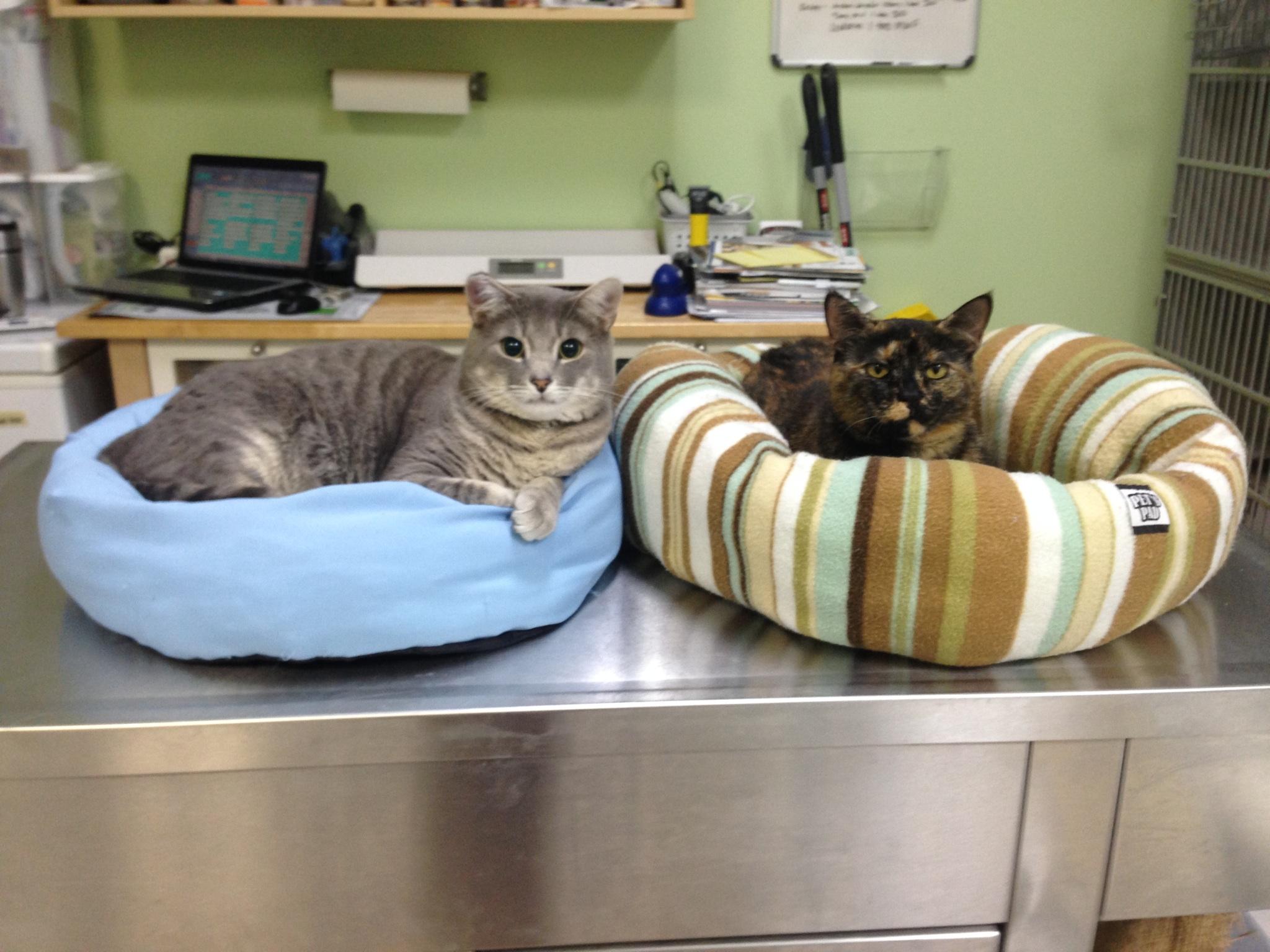
Two unrelated adult cats living together after being slowly & positively introduced.

Adopting in Pairs

Cats are a social species, but unlike humans, they do not rely on social contact for survival. They are solitary hunters but live in groups and are as social as is appropriate for them. For cats, being related is often more important than simply being familiar with another cat. We do cats a disservice by breaking up litters and families and should make a distinct effort to adopt sibling pairs, mothers with kittens, etc.

Cats — especially kittens — should be adopted in pairs. It is easier and less stressful for all involved. Changes of environment and the introduction of newcomers are the most stressful experiences cats can endure. When two cats are adopted together, they can help each other cope with the changes. Adopting more than one cat also means that the humans do not have to provide all entertainment because the cats will have each other.

Willow and Soren as kittens

These kittens have each other to help them cope with the stress of a new home, the loss of their mother & litter mates and a buddy to help them adjust to a scary human world.

Wrestle companions & socialized to their own species.
IMG_1755

Cats raised in pairs are more socially normal, more easily introduced to other cats and generally less aggressive towards humans (do not attack hands etc, unless taught to do so).

Often, having more than one cat also results in a reduction in destructive behavior. The cats can play rough and tumble with each other, so they spend less time getting into kitchen cabinets or destroying toilet paper. Not to say those things won’t happen — especially with kittens — but they will happen less often than they would with a single kitten who is bored. Kittens adopted together also have an appropriate playmate to teach them the ropes, so they are less likely to exhibit aggressive behaviors such as biting human hands and feet (unless this is encouraged and taught).

Human hands should be reserved for affection. Hunting blows can be practiced on each other or on appropriate toys. No human or dog can teach a cat, “Hey, you just bit too hard. The game is over now.” That is called “bite inhibition,” and only cats can teach other cats this lesson.

Cats learn the majority of their social skills by the time they are nine to 12 weeks of age. During those early weeks, they learn fear, aggression, and basically how to speak cat. If they miss this key window of time with other cats — say, in the case of a bottle-raised kitten or the impulse adoption of a single kitten taken from its littermates at four weeks old — they may not know what to do with their own species as adults.

Poorly socialized cats have “Tarzan Syndrome.” For comparison, imagine raising a child alone in a room, interacting only by passing a food tray under the door, and then sending that kid to college at age 18. Problems would result.) Most cats with Tarzan Syndrome are aggressive toward other cats. They will defend themselves from the cat you are trying to introduce because they never learned to interact with their own species. They instinctively tell the new cat to back off or else! 

“But I really only want one…”

If you insist on adopting only one cat, we strongly encourage you to adopt an adult cat who was raised as an only cat and has no interest in living with other cats. These cats can be extremely difficult to adopt out because so many families have multi-cat households.

It is also common for a person to think they want just one cat then realize how amazing cats are and decide to adopt another after a few years. This rarely goes well. In this scenario, it is often best to adopt a pair of kittens. The existing cat may find them less threatening, and if the kittens do end up being rejected, they will still grow up with each other so that they can learn proper social skills, how to play and spar with other cats, etc. This also ensures that the person does not raise yet another poorly socialized only-child cat. We need to break this cycle!

Compatibility Factors

When adding a new cat to a home with existing adult cats, there are several factors to consider. We humans tend to make selfish decisions without thinking of the repercussions, and adopting pets is no exception. It is important to try to maximize compatibility.

If, for example, you have a 15-year-old cat, you should not adopt a single 6-week-old kitten. Nothing could be worse! That kitten will get bigger and want to play and roughhouse. An arthritic, geriatric cat is not an evenly matched playmate. Over time, the kitten will get more and more frustrated and before you know it, there will be a full-on aggression problem. The older cat will run away, which simply evokes the kitten’s prey drive, making it seem like a game. After all, when caught, the senior kitty probably struggles and screams just like real prey.

Many people have seen a puppy perk up a senior dog and give them new life, but cats are not dogs and this is not the case with this species. In fact, it’s just the opposite; the stress of a new kitten can affect a senior’s quality of life to the extent that we can lose them prematurely to medical problems and disease.

If you have a household of healthy adult cats, the world is your oyster — within the realm of compatibility, of course. The key is to adopt cats of similar activity levels and then to introduce them slowly and positively.

A few additional facts to keep in mind: Many male cats like to engage in adolescent play behaviors well into their teens. Females, on the other hand, become much less interested in physical play once they reach social maturity at about two years of age. They still hunt and engage with toys (solo object play) but are not as interested in wrestling, though there are exceptions. Cats’ social structure is largely matriarchal, meaning that a female often rules the roost. If you end up with a house full of females, you may have a lot of vying for top-cat position. If you have a cat with a very assertive personality, it may be best to introduce an easy-going, well-socialized male who gets along with everyone.

A Lifetime Commitment

Just remember: Adoption is a lifetime commitment and cats can live well into their late teens and even into their twenties. Be committed to making it work and seek advice from your veterinarian and/or local behaviorist if you experience challenges integrating a newcomer.

Choosing to spend time together. Besties!
Adult cats introduced & living happily together.
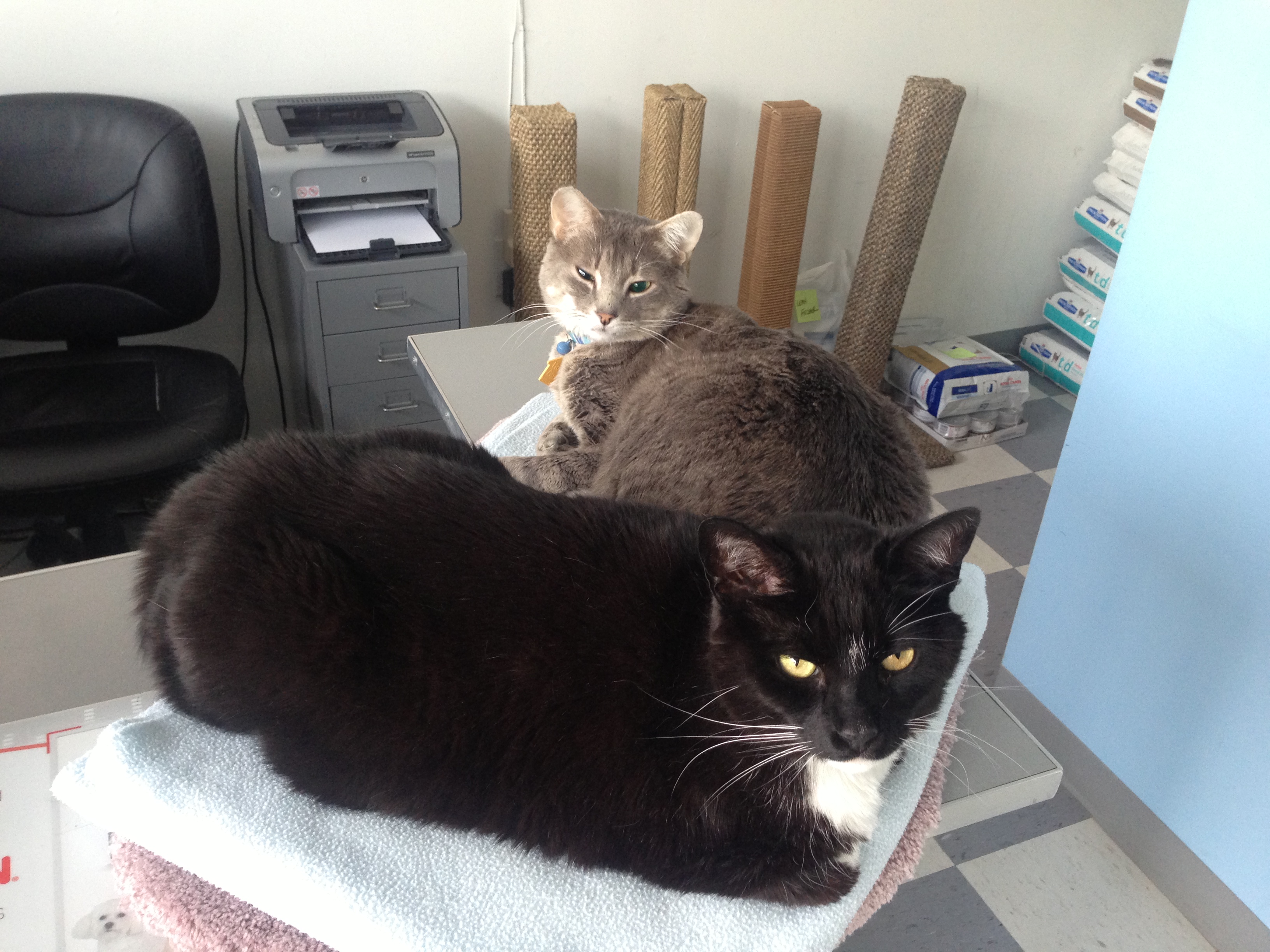
Raspy and Tucker, our clinic cats.

Written by Ingrid Johnson, CCBC Certified Cat Behavior Consultant of Fundamentally Feline  Photos property of Ingrid Johnson

Filed Under: Behavior Tagged With: adopt in pairs, adopting kittens, adopting more than one cat, don't shop adopt

How to Introduce a Cat to a Dog

Download PDF Version

With a patient and careful introduction, your pets will enjoy a positive and long-lasting relationship.

Can cats and dogs really get along? Of course they can! They can even be best friends! The first step is having a well-trained dog. Well-trained dogs are happier dogs who better understand their place in the home, and this gives you some control when it comes to introducing a new family member — a new cat, dog, or even a baby or roommate.

When introducing a cat and a dog, the steps described in the “How to Introduce Cats to Each Other” and “How to Introduce a Cat to a New Environment” handouts should still be followed. Take it slow, end on a positive note, and use high-value rewards when they are in the presence of one another.

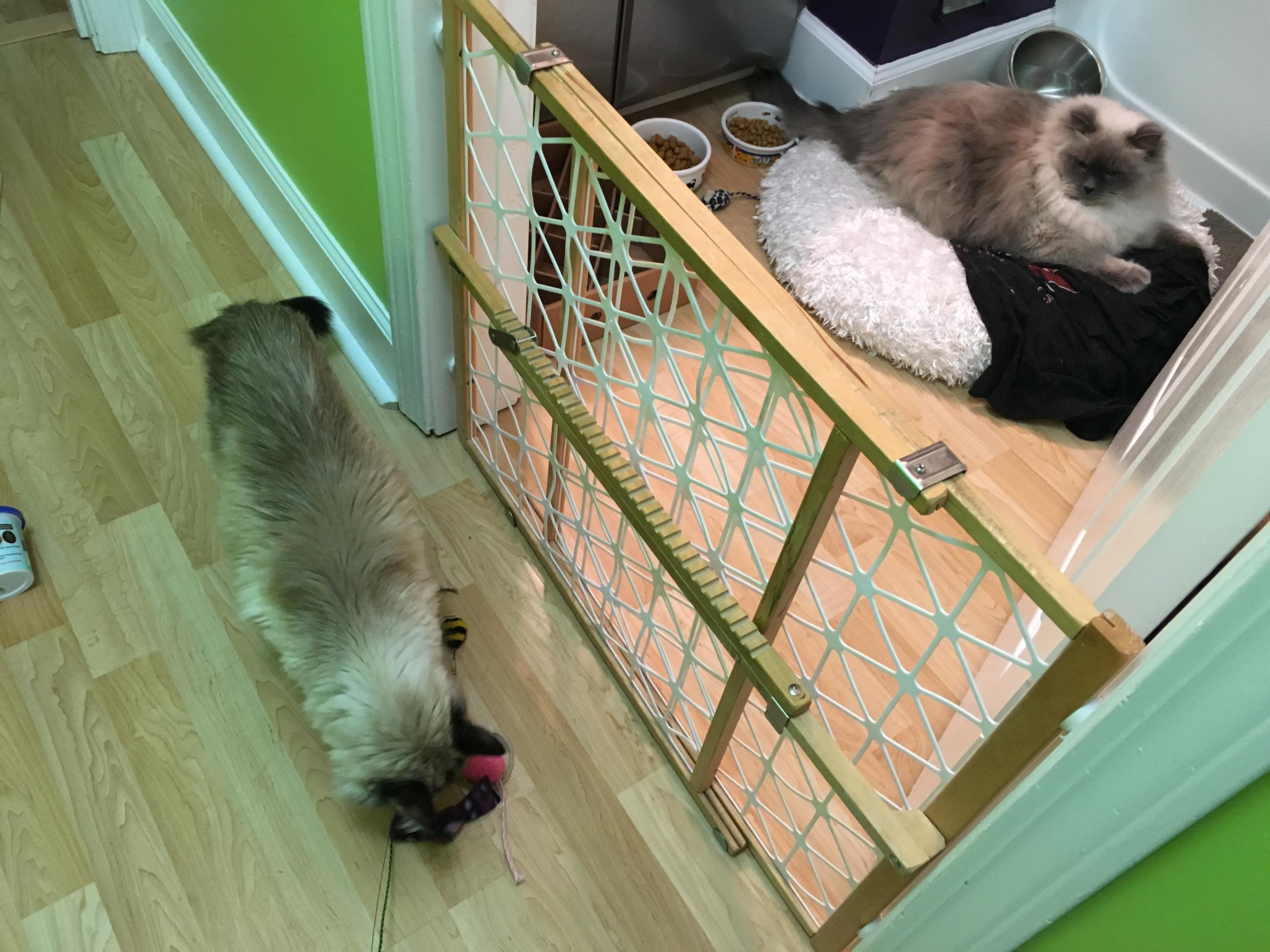
If the cat is the newcomer, they will need to start in a safe room. Find something that motivates the cat as a reward so that you can begin positive reinforcement exercises on either side of a visual barrier such as a baby gate, screen door, French doors, etc.

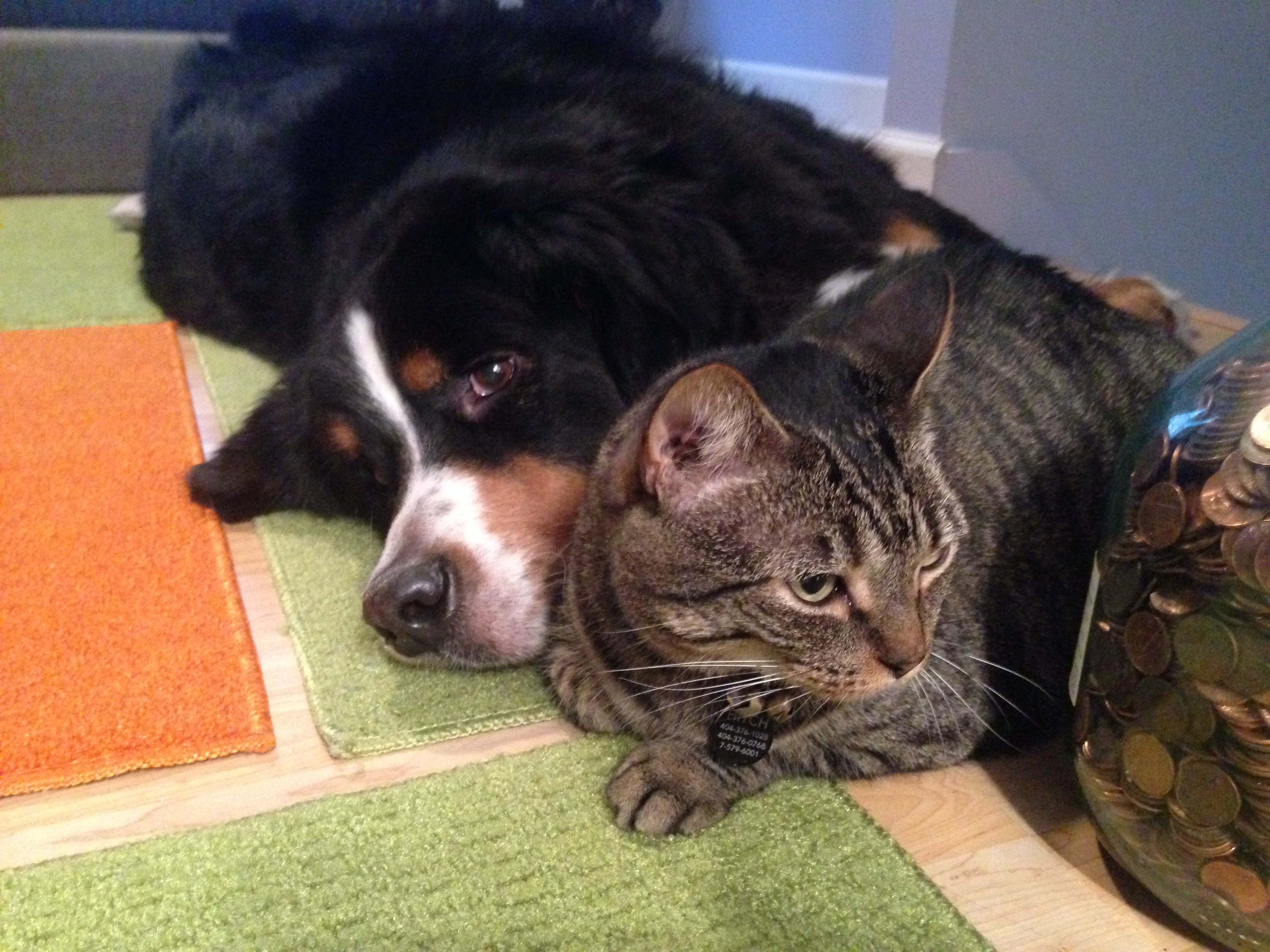
Best friends!
Best friends!

If the dog is the new family member, he or she should be contained for house-breaking and training purposes. They may have the kitchen and their crate in the beginning, but they should not be allowed to barge in and take over the house, making the cat feel like a prisoner in their once safe home. We only recommend confining the cat to their favorite, safest room of the house if they are incredibly shy and intimidated, and it is in their best interest to have their world made smaller. Otherwise, the cat should have free run and the dog must be contained.

Your cat may feel too intimidated to get to their food bowls, water, and especially litter box. Do not move their litter box! Instead, add resources in places where your cat feels safe. Abrupt change is stressful to cats, and a new dog is stressful enough. Give them more choices and options, not fewer.

Here are a few key tips:

  • Do not allow your dog to chase, bark at, or pursue your cats in any way. Cats who run get chased because running evokes the prey drive in dogs. This can be a deadly scenario. Dogs pick up their prey and shake it. And while the owners may notice no evidence but saliva on the cat, the cat may be suffering serious internal organ damage that can be fatal. Cuddling and grooming is fine, but dogs and cats should not be allowed to wrestle or rough-house together.
  • Create vertical space so that your cats can get up and away from the dogs. This is key for the cat’s sanity and sense of security, as well as for their safety should an unsupervised chase ever ensue. Cats take great comfort in being up high. Make sure the dog respects the cat condo; paws off for dogs! This is usually only an issue with toy and agile breeds.
  • Create feeding stations up high so that the dogs do not scarf down all of the cats’ food. Remember that cats are the most three-dimensionally oriented species we share our homes with, so there are no hard, fast rules about the food dish being on the floor. Bathroom vanities, armoires, and cat condos are all great locations for cat food.
  • Always offer a separate water dish for cats. They may drink from the dog bowl too, but cats are very finicky about the taste of their water, and dog slobber could taint it enough to prevent them from drinking.
  • Put a baby gate up to keep the dog out of the litter box. Lift the gate a few inches so that cats can go under or over it. If you have a very small dog, you may have to get more creative, but know that hooded litter boxes are not the solution. Elimination is a vulnerable time for a cat, and hooded boxes can make them feel threatened because they cannot see the dog approaching. Most dogs can also fit their head inside the opening; imagine how scary that would be if you were a cat using the box!
  • Training your dog to understand the “leave it” and “drop it” commands will allow cats to have toys, food puzzles, and free access to the litter box. Many homes with dogs are void of cat toys because the dog eats or destroys all of the cats’ things. This is extremely unfair. Do not allow this to happen to your once happy cat.
  • Monitor your cat when your dog is eating. Cats should NOT eat dog food. It is not balanced or made for them and can cause urinary problems.
  • Contact between a dog and a cat should always be initiated by the cat. Even if the cat gives the dog a warning swat with a paw, the dog should not retaliate. The goal is not for the dog to be injured, but for them to realize that the cat comes equipped with sharp pointy things that should be avoided!

It cannot be stressed enough that supervision is imperative when introducing dogs and cats. Do not leave the dog and cat alone unsupervised until you are 100% sure the dog will not attack the cat under any circumstances. Since this is a very high expectation, and there are many cases of dogs attacking and killing the family cat after years of living together, you are wiser to keep them separated or keep the dog crated while you are not home.

Dominance training, shock collars, pinch collars etc. are outdated methods that are not nearly as effective as positive techniques. Animals learn best using positive reinforcement. Reward behaviors you like, ignore behaviors you don’t. This works best for all species (humans too)! Please contact your veterinarian to get a recommendation for a positive reinforcement dog trainer in your area.

Congratulations on your new addition! With the techniques described here, you can successfully introduce cats to dogs. With time and patience in the beginning, your household will have long-term harmony, and your pets will have a positive and long-lasting relationship.


Written by Ingrid Johnson, CCBC Certified Cat Behavior Consultant of Fundamentally Feline  Photos property of Ingrid Johnson

Filed Under: Behavior Tagged With: cats and dogs, introducing cats to dogs

How to Introduce a Cat to a New Environment

Download PDF Version

Helping a new cat get comfortable in your home involves much more than opening the carrier door.

Regardless of whether there are existing pets in the household, you should not give a new cat(s) the run of the house when you bring them home. Instead, create a safe room where they will remain until they tell us that they are ready to start exploring their new home and potentially meeting the existing cats.

Welcome home!

Their safe room should be a cozy area; cats feel comfort in small, confined spaces. Cats are both predator and prey, so when presenting them with a new environment, it is best to start small and allow them to acclimate slowly. This keeps them from feeling threatened and is especially important if the cat is shy or under-socialized. Hiding places should be available, and the cat should be allowed to come out at his or her own pace. Avoid using rooms where the cats can get under large pieces of furniture, such as beds, where you cannot access them, pet them, play with them, or offer treats and encouragement. This is especially important if the cat is timid.

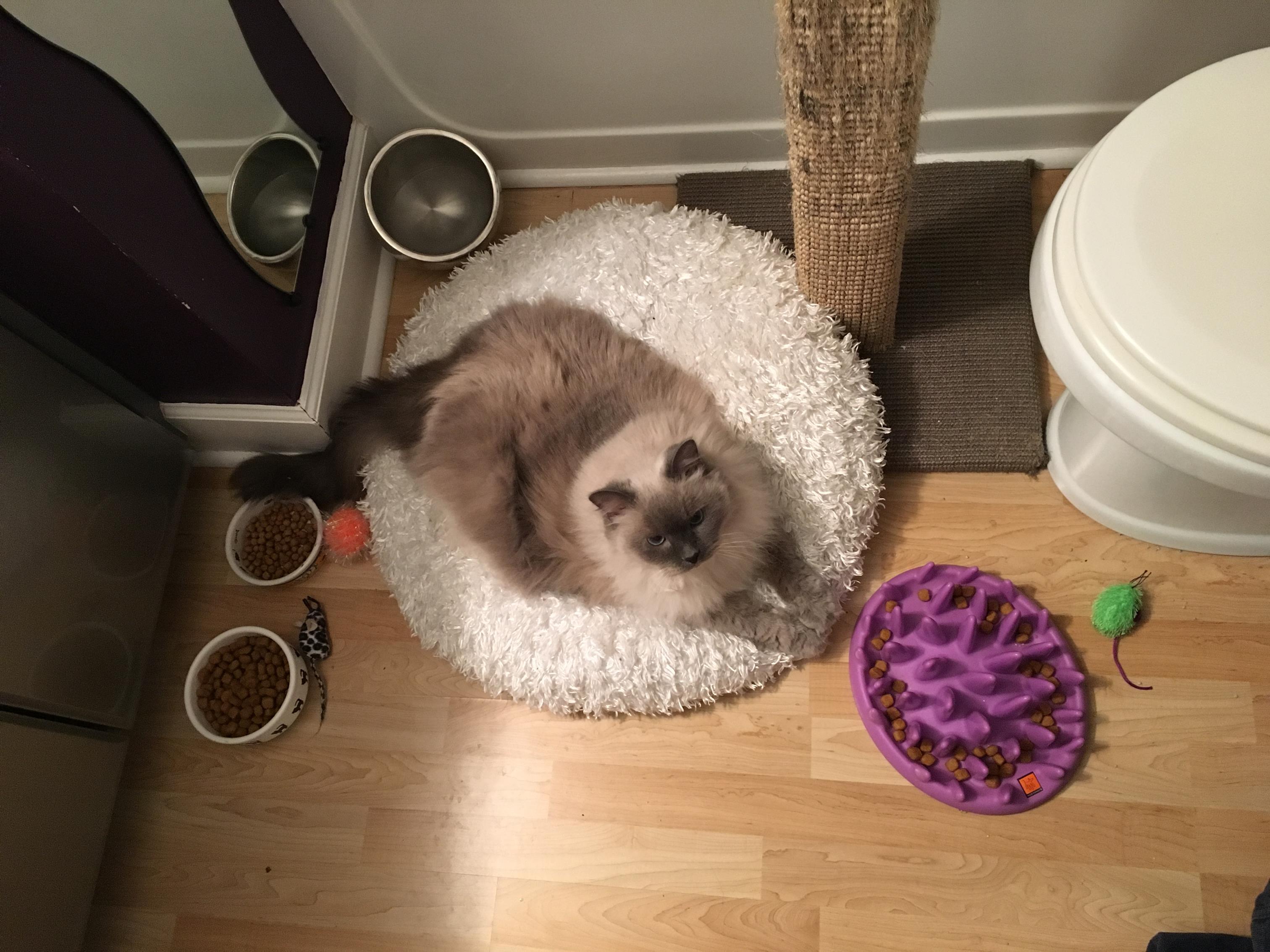
Safe room set up example, adult cat in small bathroom.
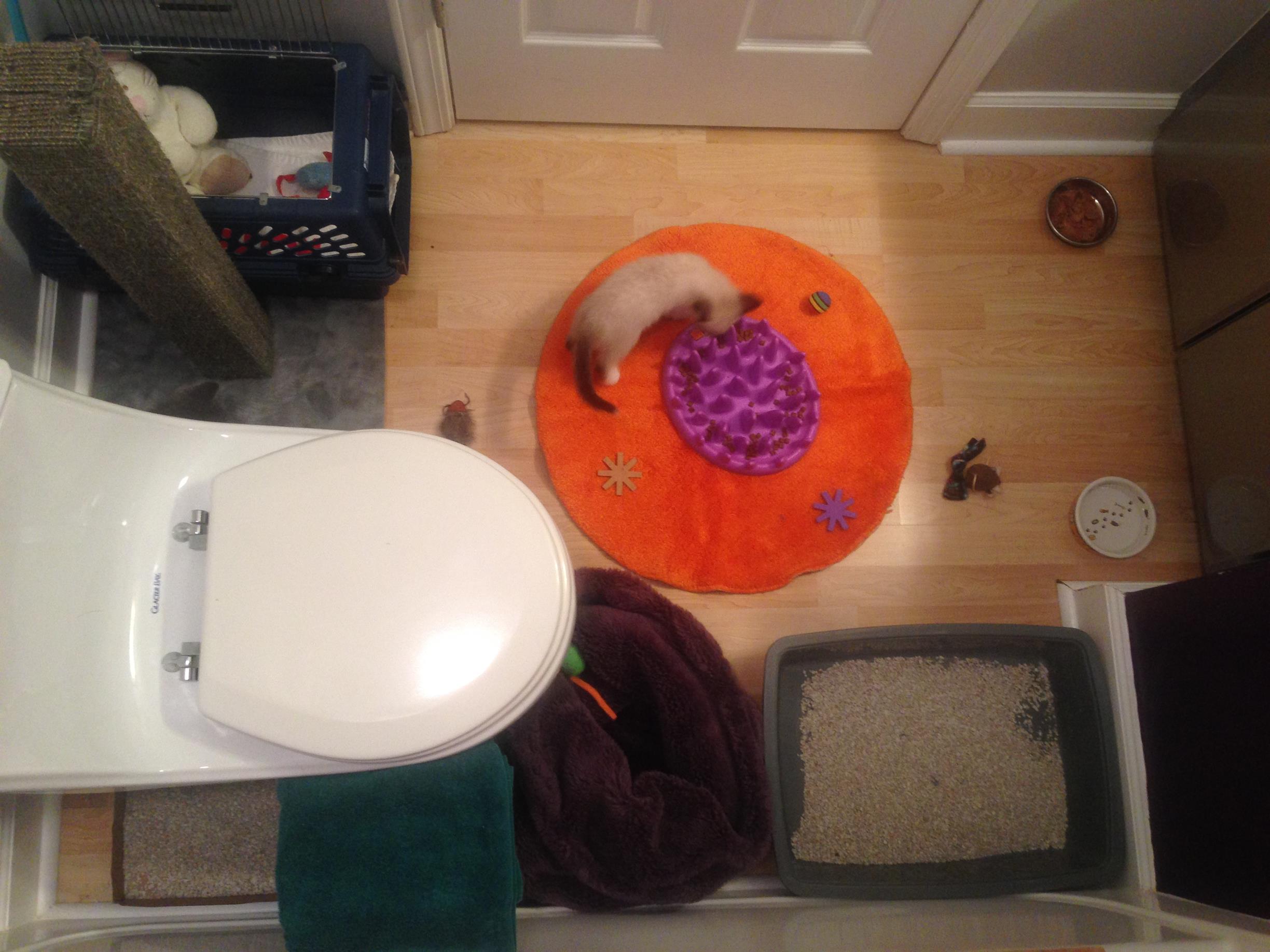
Safe room set up example for two kittens also in a small bathroom.

Set them up in a room where you will be comfortable having resources (food, water, litter) long-term, potentially forever. Cats are creatures of habit and do not welcome abrupt change. Moving everything out of their safe room to suddenly convert it back into a guest room can be very stressful and result in unwanted behaviors such as eliminating where their litter box used to be or forgoing eating.

Make sure that all of the cat’s needs are met in the safe space. Set them up for success! Include at least one scratching post. This is your chance to start them off right, so if you adopted kittens, don’t offer puny kitten products! Give them the real thing that they would use as an adult cat.

If space allows, offer more than one litter box. Cats prefer to urinate in one area and defecate in another. Be sure to offer food, water, solo toys (so they can play when they feel safe and comfortable) and cozy, fuzzy beds. If they will be introduced to other cats, offer easily exchangeable bedding. We will use that later in the process (see our “How to Introduce Cats to Each Other” handout for more information).

This safe room provides several advantages. It’s a place where your new cat can get used to you and other members of the household without feeling overwhelmed by the entire home. If there are other pets in the household, make sure they are not in the room to further intimidate your new cat while they’re exploring this strange new place. Also, as you begin to let the new cat out of the room and into the rest of the house, ensure they can return to their familiar safe place if they start feeling insecure or out of their comfort zone.

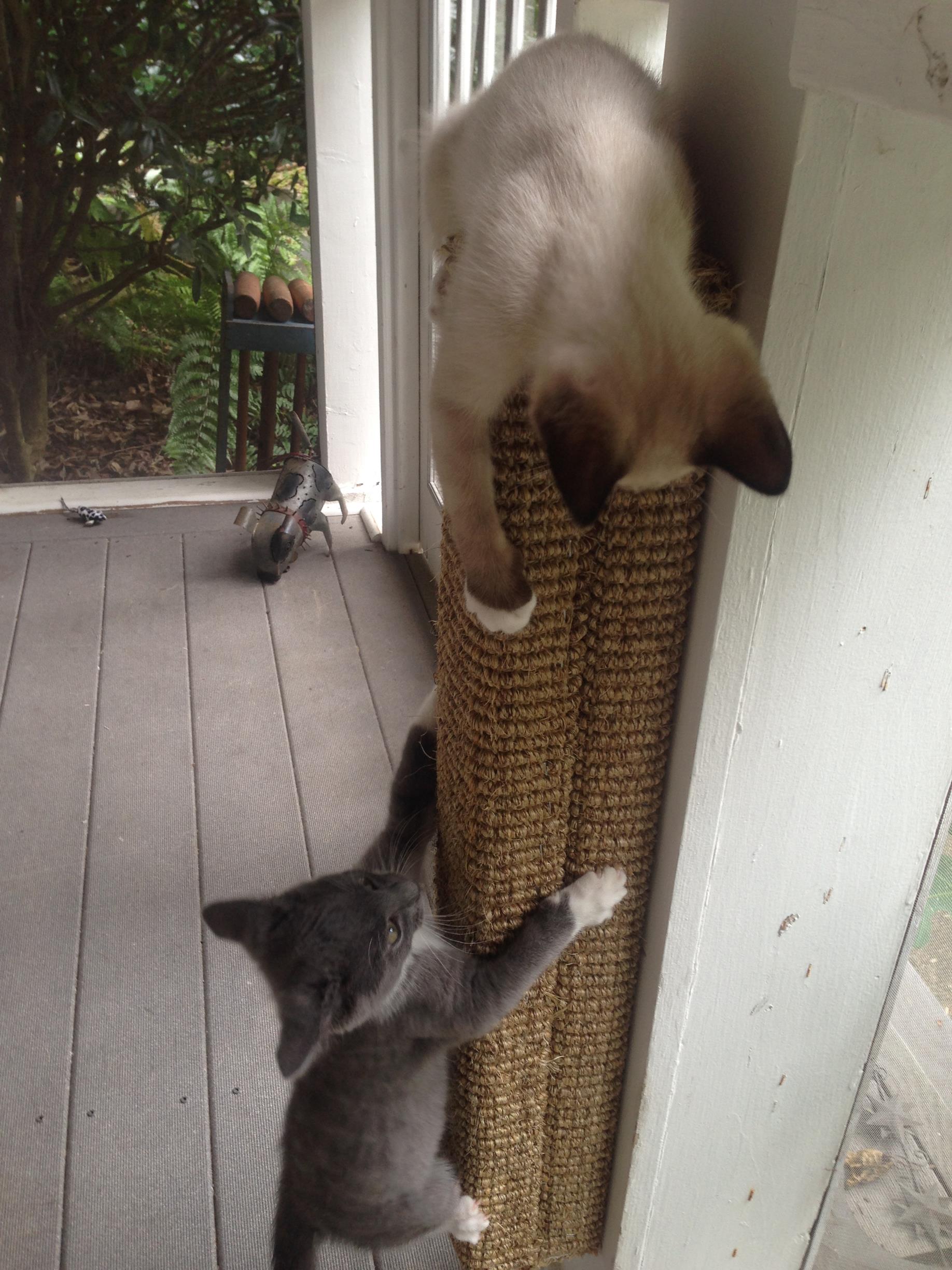
No puny scratching posts for kittens! Give them the real thing to start them off right!

Safety Tips

Make sure the room, as well as the rest of the house, is “cat-proof.” Even if you already have cats who don’t chew on things like electrical cords, your new cat may find them fascinating and can get seriously injured or worse while playing. Also check for strings, ribbons, and small objects that can be swallowed, possibly leading to emergency surgery or even a fatality. Be sure that holes in walls, A/C vents, and ducts are all secured. You will be surprised what a scared cat can fit into!

Be sure your new cat is microchipped and start acclimating them to wearing a collar. You never know if you will have an emergency like a break-in or house fire. Be prepared! The best form of ID, should your new cat escape from the home, is a safe cat break-away collar with a microchip as a back-up if the collar comes off. 

Acclimating to the Safe Room

When you bring your new cat home, immediately put them in the safe room with the door closed. Open the carrier and let them come out on their own. If there are other animals in the house, it is imperative that you do not set the cat carrier down and allow the existing animals to approach. This is threatening and frightening to the cat trapped in the carrier!

Initially, they may be shy or frightened and may find a place where they can gather themselves and feel safe before checking things out. Cats feel safe either under things (beds, couches) or up high (cat condos, dressers, cabinets). Eventually, they will begin exploring their new digs, often at night when it is dark. Offer nightlights in the safe room. A cat’s vision is at its best in low, dim light.

Over the next few days, make sure the cat is eating well and using the litter box. Any kind of change can be stressful to a cat, and moving to a new home is one of the most stressful events your cat will encounter. Because of this, it is not uncommon for cats to break with a cold or other illness after moving to a new home. Call your veterinarian immediately if you notice signs of illness.

Once the new cat is eating, drinking, and eliminating normally, it is time to start the introduction process to the rest of the home and/or to the other pets. You will know they are ready when they are eager to see you when you enter the room and curious about what is on the other side of the door. If they are still frozen with fear and hiding, it is not time to move forward to give them even more space. They will only feel more overwhelmed.

You will have the rest of your lives together. DO NOT rush or force things, as humans tend to do. Even when we think we are taking things slow, it is never slow enough for a cat!


Exploring the House

You may simply open the door so that your new cat can exit the room and retreat back to the safe room if needed. DO NOT force them to exit their safe room. Some cats will be perfectly content in this new room for weeks. Others will be eager to explore. Always go at your cat’s pace.

Place resources throughout the home, so as your new cat peruses the place, they learn where other sources of food, water, litter, and scratching posts are located. Use food, treats, and interactive lure toys to make the exploration a positive and fun experience!

Allow them to cruise around the home for 15 to 30 minutes, but confine them again at their next mealtime or before they get overwhelmed. You want to ensure that each exploration session ends on a positive note, not something scary that causes them to bolt around the house! It is also great to lure them back into their safe room using an interactive toy. This way, they actually go back in of their own free will and you have not “locked them up.”

Gradually increase the amount of time they are allowed outside of their safe room, eventually only putting them back in when you cannot supervise (in bed, at work). Depending on the individual cat or kitten’s needs, most will be able to enjoy the run of the house within a few weeks.

For more timid individuals, you may start by placing a baby gate across the doorway threshold before opening the door all the way. They may feel more inclined to approach the threshold with this “visual barrier” in place. You can then feed them their meals at this visual barrier, eventually removing it and feeding them in the open doorway threshold. You can utilize food or play to encourage them to take a few steps out of the room. Play increases confidence and decreases stress. Use this tool to your advantage. They may only come two feet out of the room before retreating back, but that is okay! Use play to lure them out of the room AND back in to increase their confidence to cross the threshold.

By taking things slowly and using the techniques described here, your new cat will grow to feel comfortable and confident in their new home.


The other cats are confined so there are no threats during exploration.
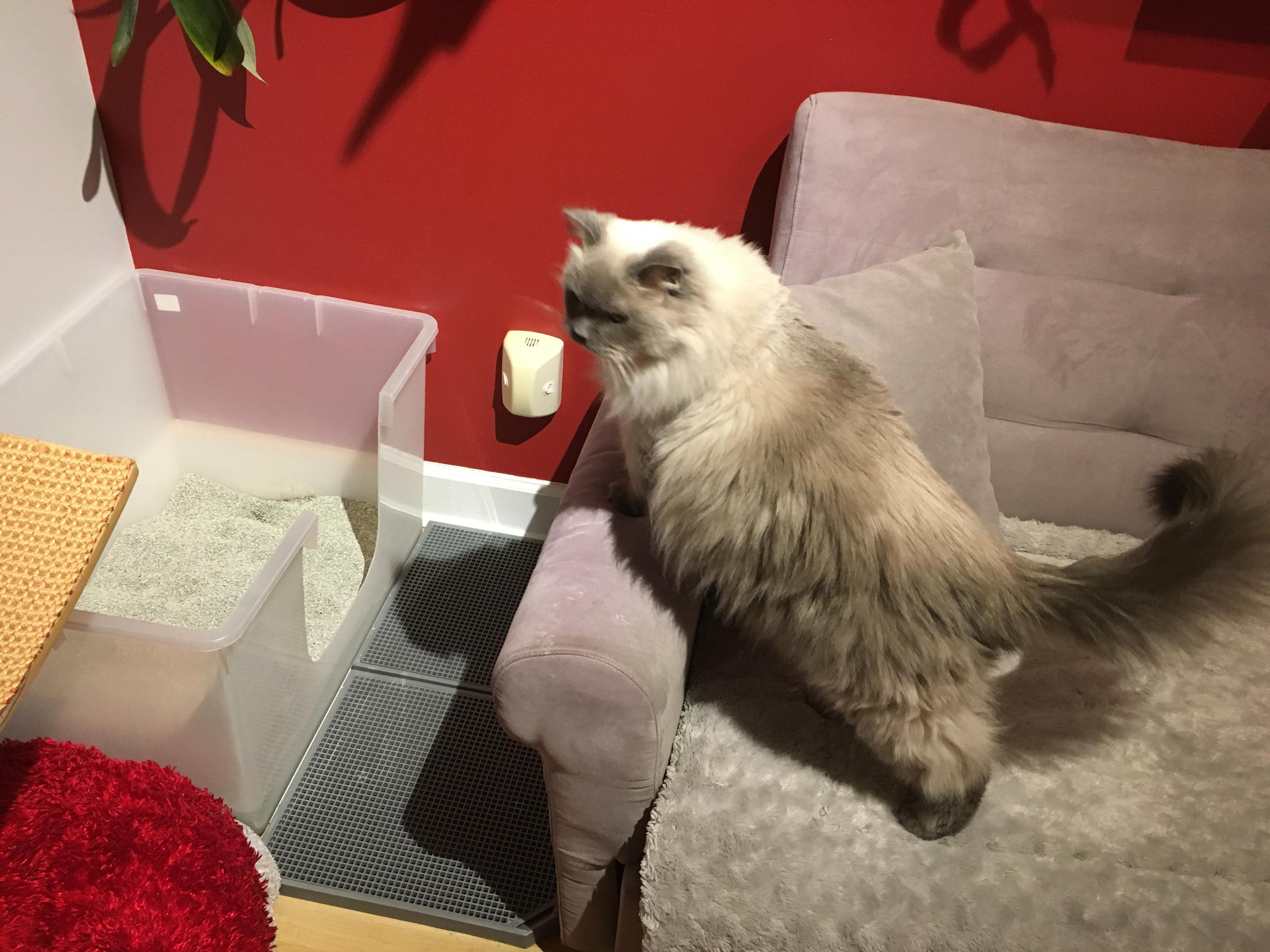
Seniors often do not require double stacking.

Written by Ingrid Johnson, CCBC Certified Cat Behavior Consultant of Fundamentally Feline  Photos property of Ingrid Johnson

More Information

If you will be introducing your cat to other cats, please see our “How to Introduce Cats to Each Other” handout. If you will be introducing your cat to a dog, please see our “Introducing a Dog and a Cat” handout.

Filed Under: Behavior Tagged With: Introducing cats, Introducing cats to a new home

  • « Previous Page
  • 1
  • 2
  • 3
  • 4
  • …
  • 9
  • Next Page »

How to Find Us

4719 Lower Roswell Road, Suite 220

Marietta, Georgia, 30068

Phone: (770) 579-6001
Fax: (770) 579-6013

catspwc@pawswhiskersandclaws.com

Read our reviews on Facebook!

By Appointment Only

Monday 9 am - 5:30 pm
Tuesday 9 am - 5:30 pm
Wednesday Closed
Thursday 9 am - 5:30 pm
Friday 9 am - 5:30 pm
Alternating Saturdays 9 am - 1 pm
Sunday Closed

Copyright © 2026 Paws, Whiskers, & Claws